
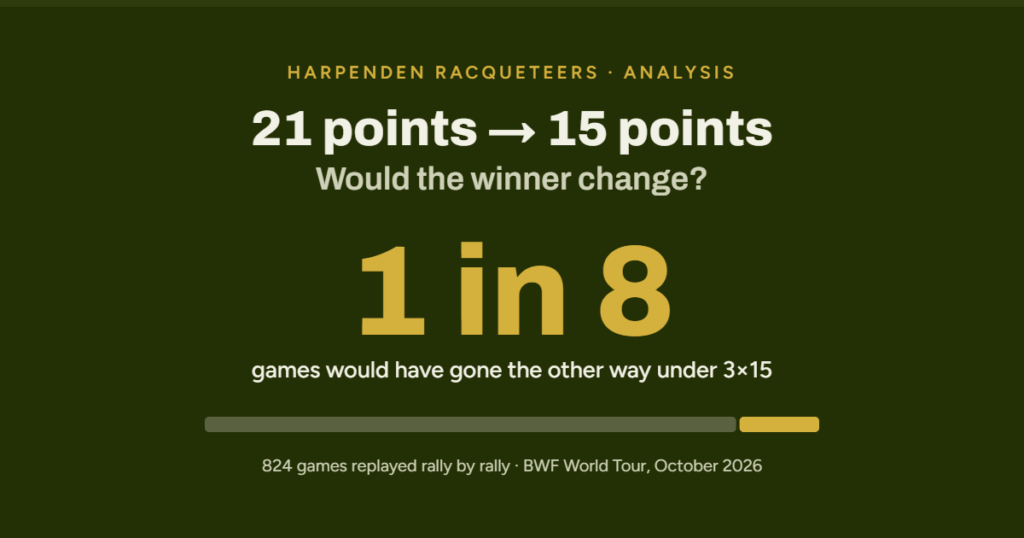
From 4 January 2027, international badminton switches from three games to 21 to three games to 15. So how often would the shorter game have produced a different winner? We replayed every rally from two BWF tournaments this week to find out.
What’s changing
Under the new BWF rules, each game is played to 15 points. At 14-all you need a two-point lead, with a cap at 21, so at 20-all the next point wins. Matches are still best of three, rally-point scoring stays, and the mid-game interval moves to 8 points. National associations and clubs can choose to keep 21-point scoring for domestic play.
How we tested it
BWF’s Match Centre logs the score after every rally while a tournament is live. We collected the full rally-by-rally record for 352 completed matches (824 games) from the YONEX French Open (Super 750) and the POLYTRON Kudus Indonesia Masters (Super 100), 20–24 October 2026, covering qualifying through to the semi-finals in all five events.
For each game we ran the same rallies through the 15-point rules and checked whether the same side would still have won. Retirements, and a handful of matches where BWF’s own point log didn’t add up to the official score, were left out.
One game in eight changes hands
Of 824 games, 108 (13%) would have gone to the other side. These are games where one side got to 15 first but was then overhauled before 21.
The closer the game, the more likely the result flips
Share of games that would change winner, by the final winning margin under 21-point scoring
It’s almost entirely a close-game story. Nearly half of games won by two points would have been lost at 15, and a quarter of those won by three. Once the winning margin reached six points, not a single game changed hands: if you were that far ahead at the end, you were already ahead at 15.
Men’s doubles is most affected
Games that would change winner, by event
Share of games where the side leading at 15 lost at 21
Men’s doubles stands out at almost one game in five, perhaps reflecting how quickly momentum swings in the fastest discipline. The other four events are bunched together at 11–13%. With one week’s data, the gaps between those four are well within chance.
Picture it: an 8–15 deficit turned into a 23–21 win
Rally by rally: a comeback the new scoring would have cut short
Mixed doubles, first round, Kudus Indonesia Masters, first game
Pair B raced to 15–8 after 23 rallies: game over under the new rules. Under the current rules Pair A had six more points of runway, won 15 of the next 21 rallies and took the game 23–21. Comebacks like this are exactly what the shorter game will cut out.
What about whole matches?
Match outcomes when the same rallies are scored to 15
352 matches, ignoring changes to who serves first
Because a match needs two games, one flipped game often doesn’t change the overall result. 19 matches (5%) would have had a different winner outright. A further 54 (15%) would have gone to a third game that was never played. So somewhere between about 1 in 20 and 1 in 5 match results could change, depending on how those deciders went.
A pinch of salt. This replays real rallies under new rules, but players won’t play a 15-point game the same way. Expect faster starts, earlier risks and different use of the interval. It also covers one week of top-level badminton, so treat the event-by-event numbers as a first look rather than the final word.
What it means on court
- Starts matter more. There’s less time to play yourself in: a slow opening is much harder to recover from.
- Close games get more random. If a game is going to finish within two or three points, the shorter format makes the result noticeably more of a coin toss.
- Matches get shorter. Games averaged 37 rallies under 21-point scoring and would have averaged 26 under 15, about 30% fewer.
Fancy testing it for yourself? Try a few games to 15 at club night and let us know how it feels.
Sources: BWF, Key Changes Under the 3×15 Scoring System (26 April 2026); rally data from the BWF Match Centre, YONEX French Open 2026 and POLYTRON Kudus Indonesia Masters 2026, 20–24 October 2026. Analysis by Harpenden Racqueteers.