
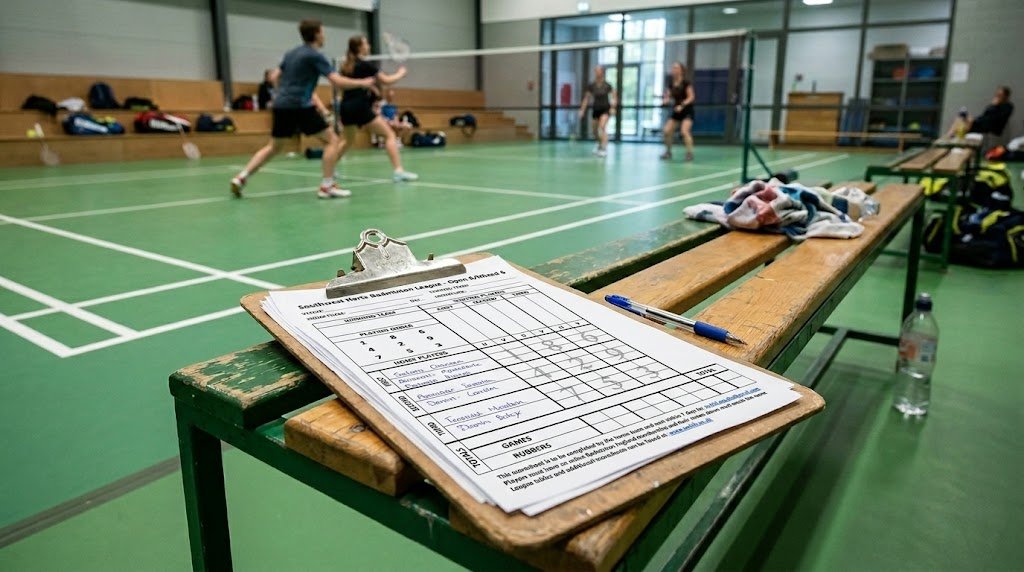
When a court comes free and the next rubber on the scoresheet can’t start because one of its pairs is still playing, should you wait for them, or put on another rubber whose pairs are ready?
This question comes up in Men’s and Mixed matches, where three pairs from each side play nine rubbers. To answer it we simulated 100,000 matches. We also looked at what happens with three courts, whether our scoresheet order is a good one, and how much the answers depend on how long rubbers last.
The short answer
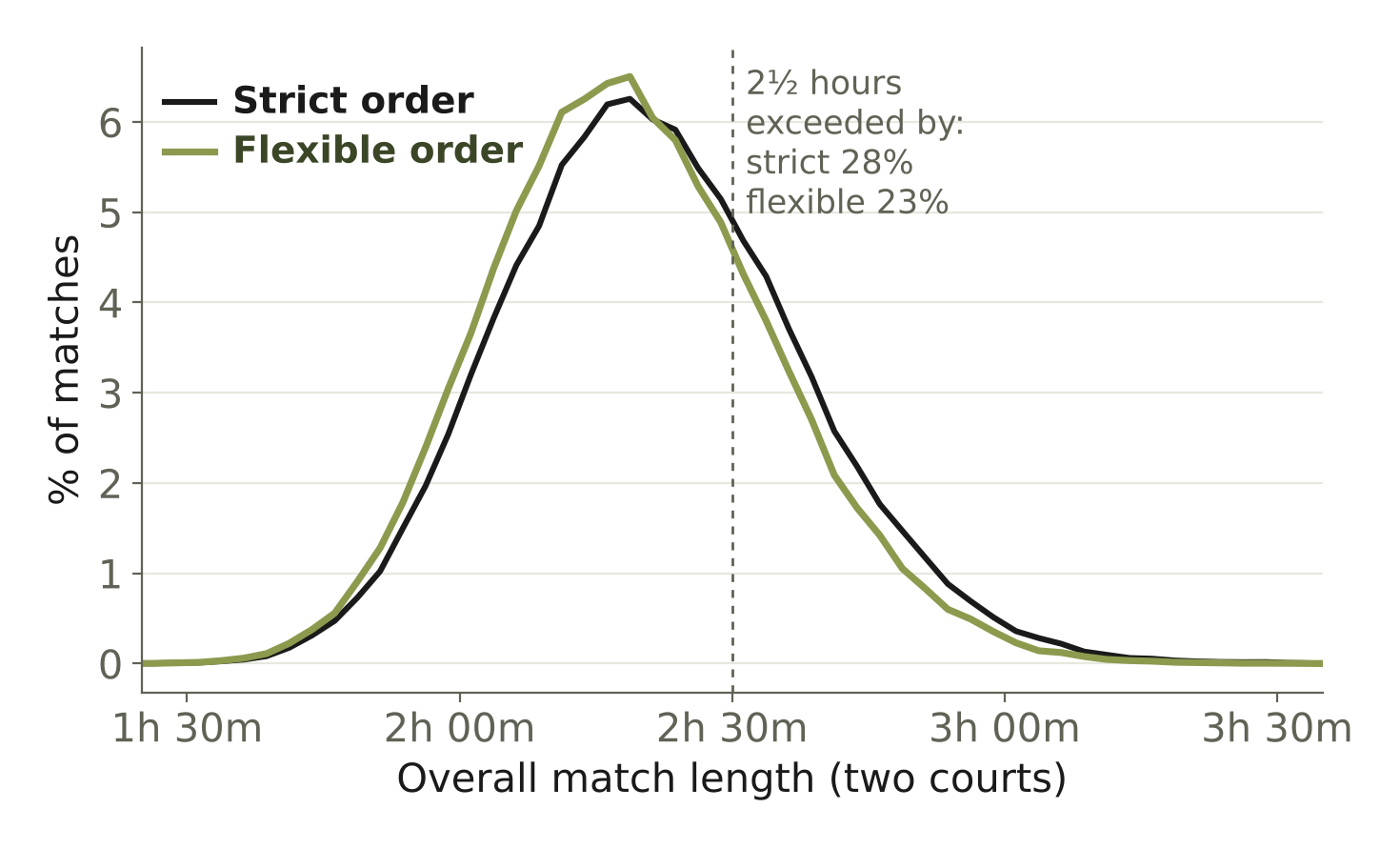
With two courts, be flexible. If the next rubber can’t start, put on the next one down the scoresheet whose pairs are both free. Most of the time it makes no difference. When it does, it usually helps. On average a match takes 2h 21m in strict order and 2h 19m in flexible order. The chance of a match running past two and a half hours falls from 28% to 23%.
With three courts, stick to the scoresheet. Here jumping ahead backfires: flexible order made the match longer in 79% of simulations, by 8 minutes on average.
Our scoresheet order itself is already among the best of the 10,080 possible orders, so there is no reason to change it.
How much time does it save?
The chart shows the time saved by flexible order in every two-court match where the two approaches gave different results. Bars to the right (olive) are matches that finished sooner; bars to the left (red) are matches that finished later. The matches where it made no difference (59% of them) are left out.
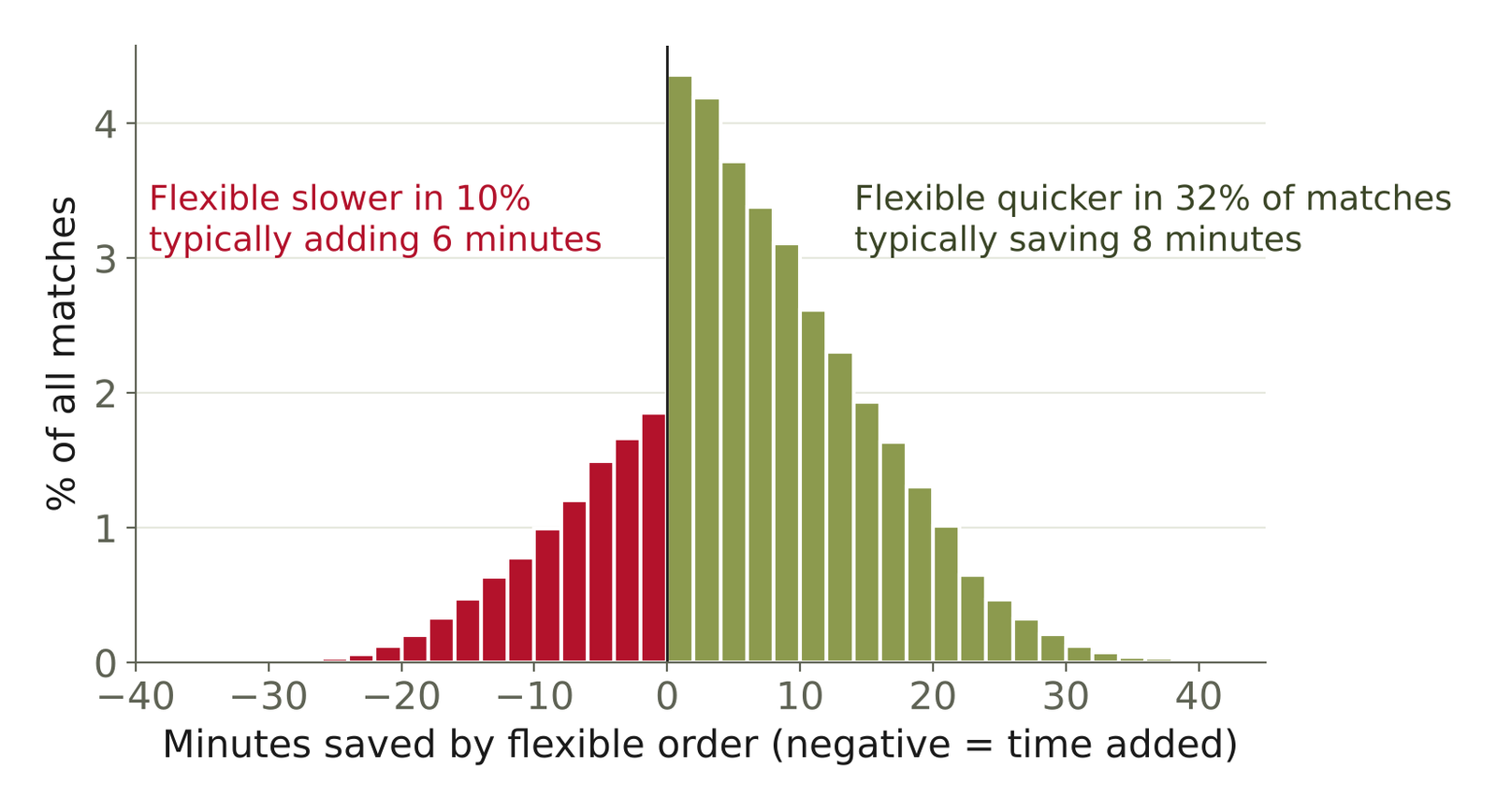
Across all matches, including those with no difference, the average saving is a modest 2.3 minutes. The benefit is not that every match is a little quicker. About one match in three finishes around ten minutes sooner.
Why it happens: three real examples
Each picture below follows one simulated match from the first shuttle to the last. Each block is a rubber, labelled with its scoresheet number and the home pair against the away pair. Red hatching shows a court standing empty. Light olive marks a rubber that flexible order played earlier than the scoresheet says. Each example uses the same rubber lengths under both rules.
1. Flexible order fills the gap, but the match ends at the same time
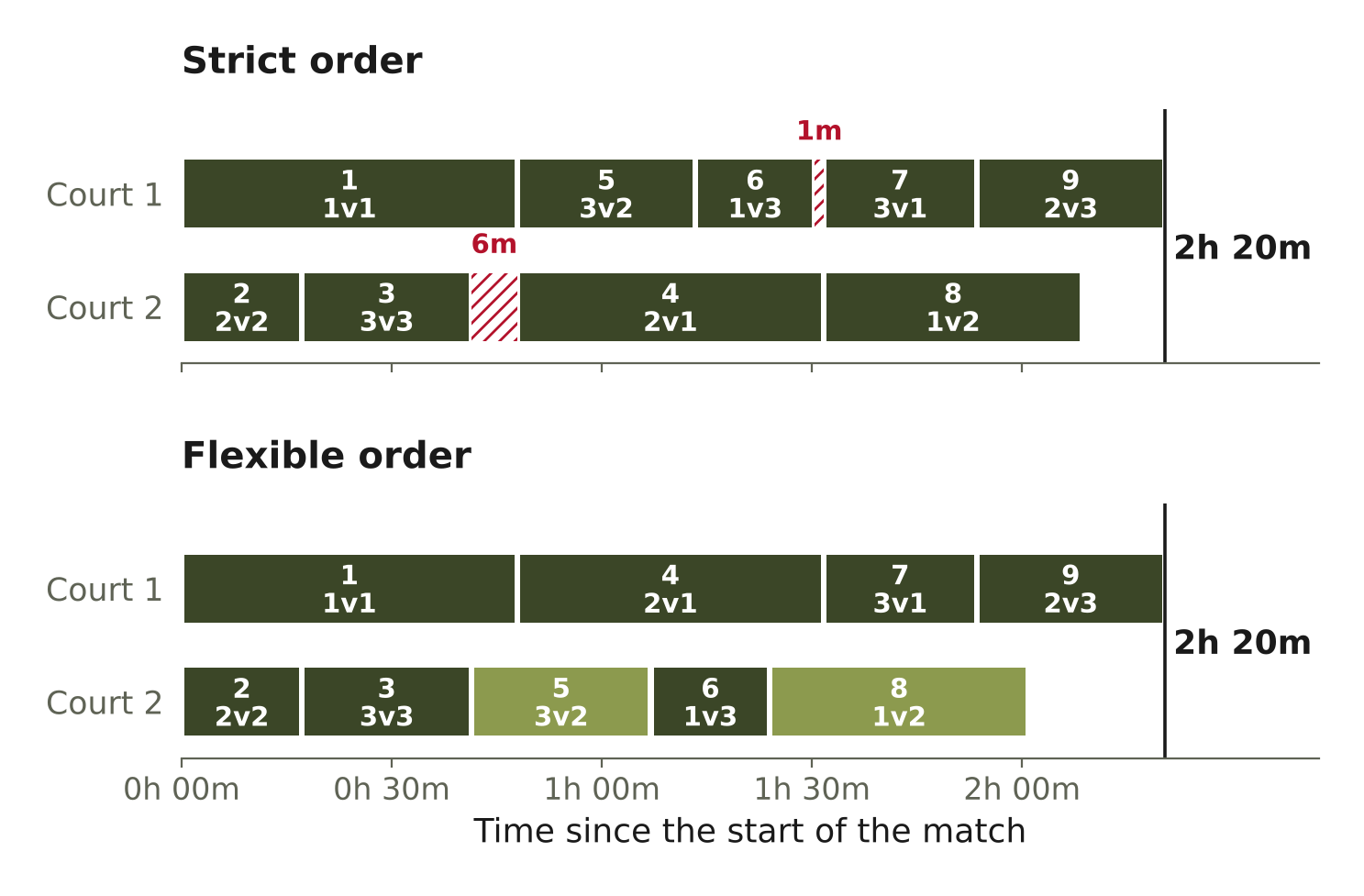
2. Flexible order makes the match longer
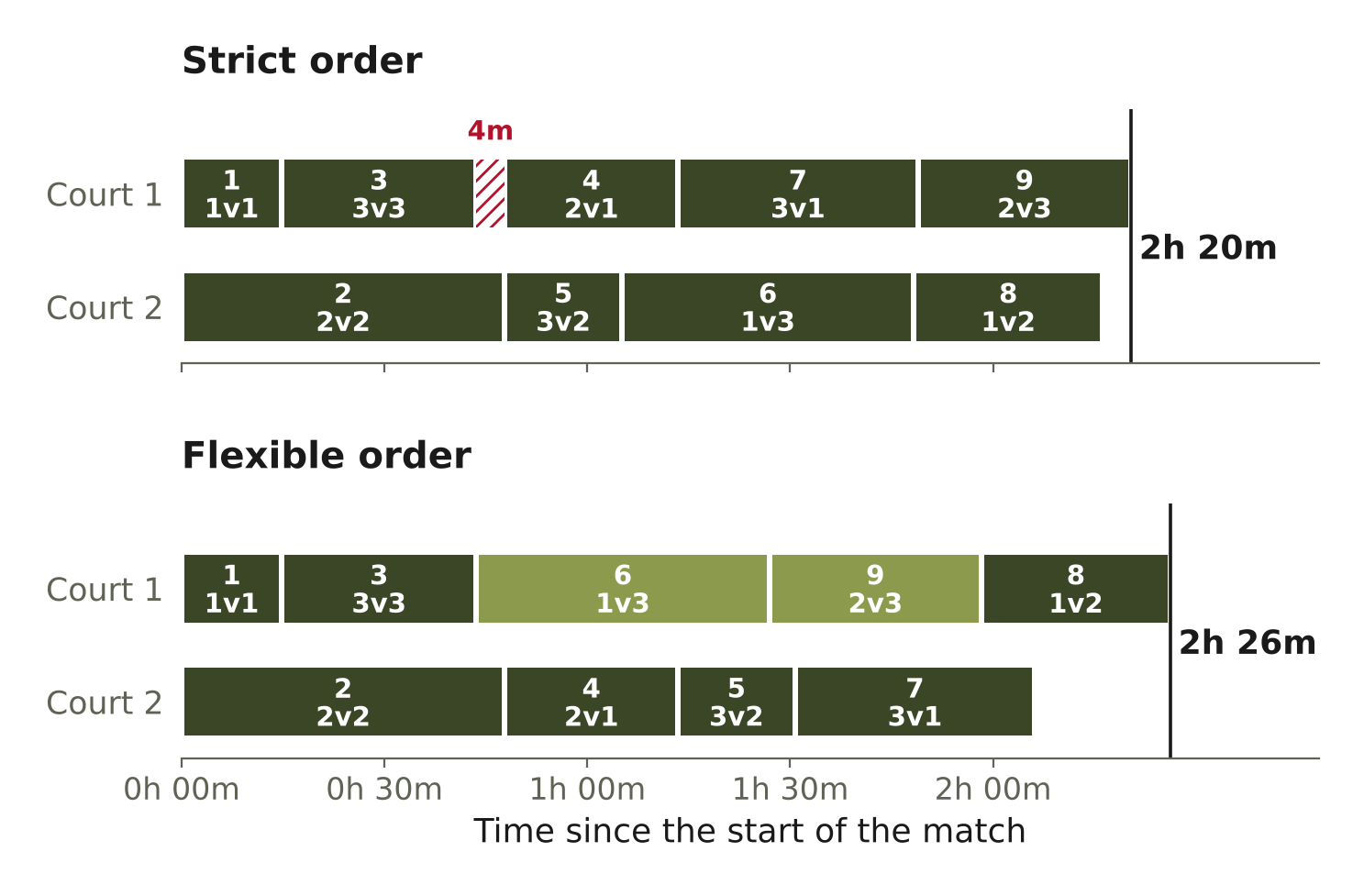
3. Flexible order makes the match shorter
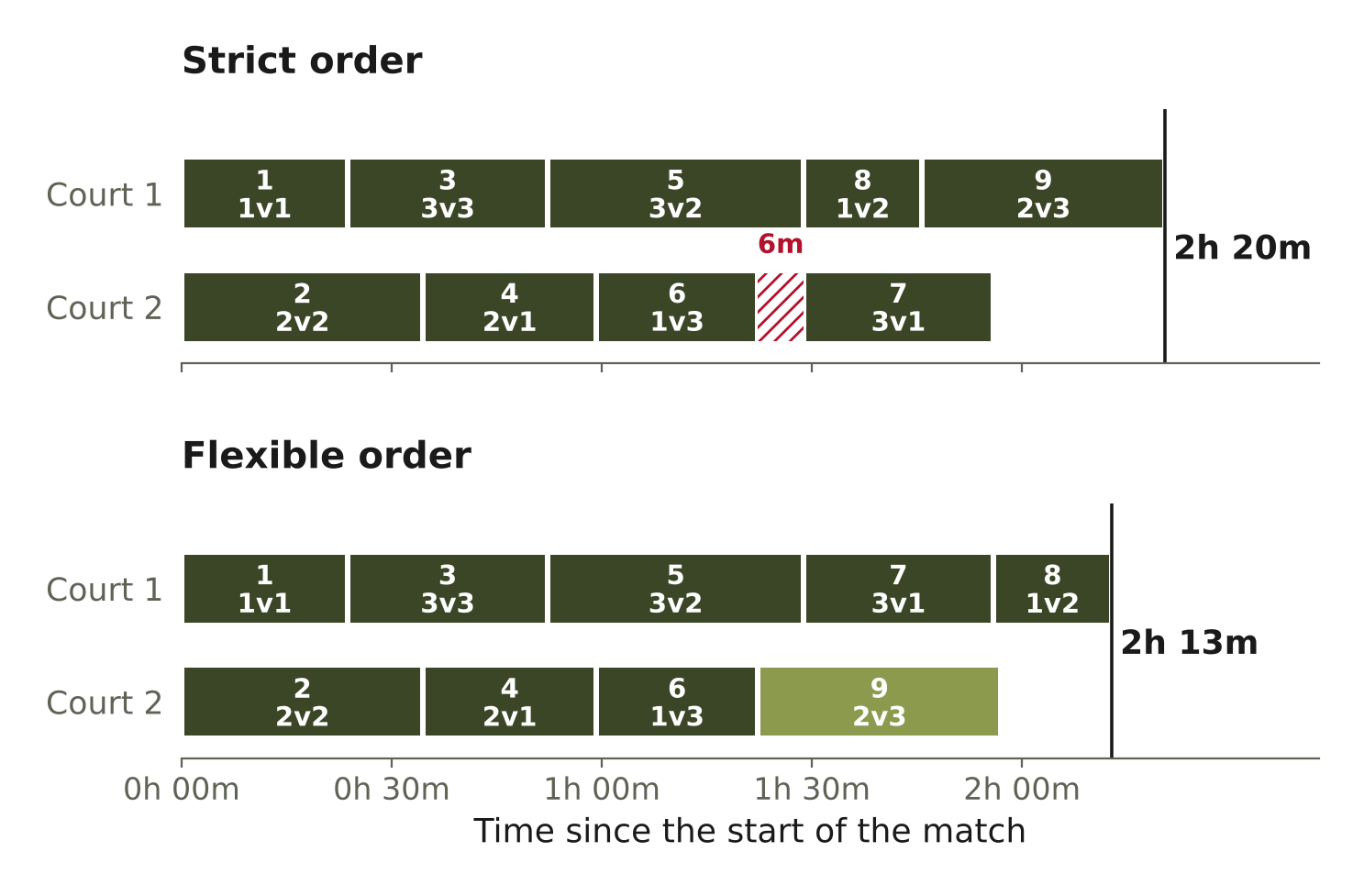
What if we have three courts?
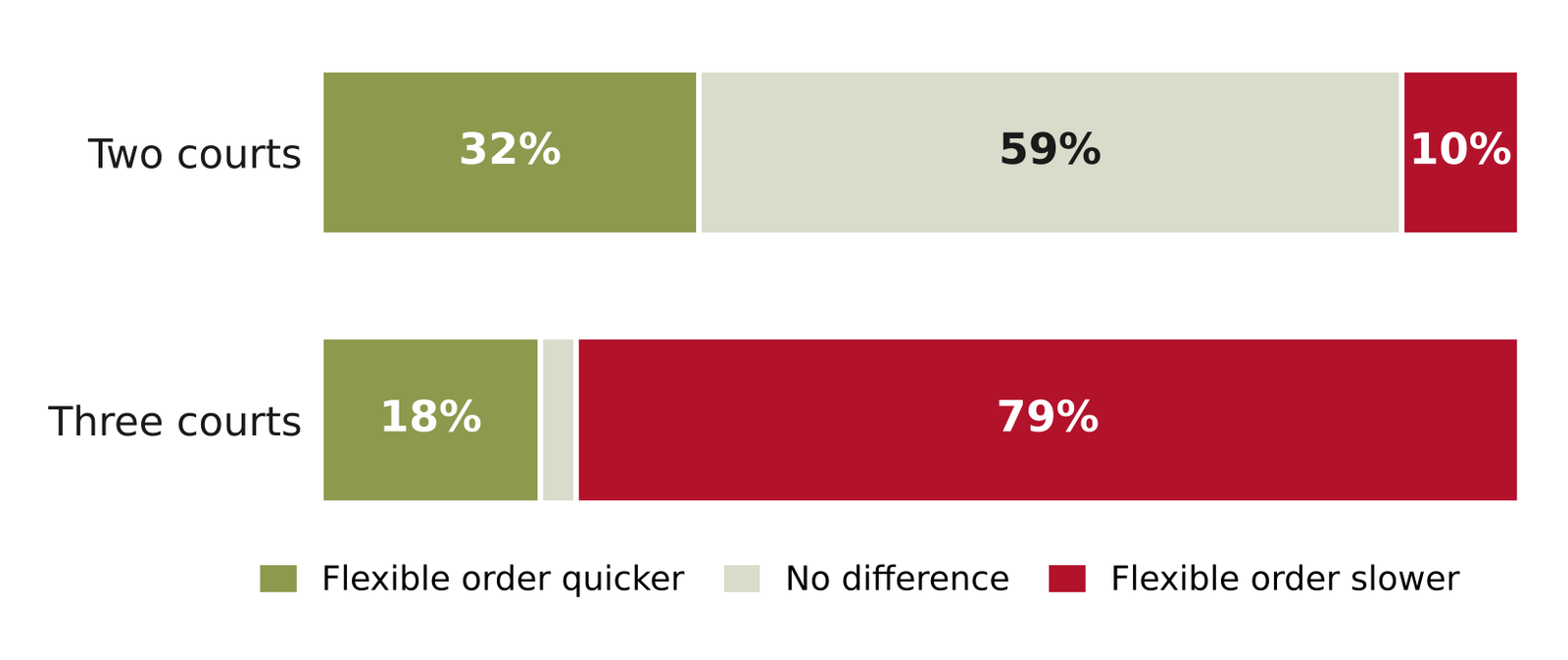
With three courts the picture reverses. In strict order a match averages 1h 49m; in flexible order it averages 1h 58m. Flexible order is slower in 79% of matches.
The scoresheet is built in three rounds of three rubbers, and within each round every pair plays exactly once. With three courts, each round can go on at once. Grabbing whichever rubber is ready first breaks up those rounds. Soon every rubber left needs at least one pair that is still playing, so a court sits empty anyway.
Is our scoresheet order a good one?
There are 10,080 genuinely different ways to order the nine rubbers. We tested every one with two courts and strict order.
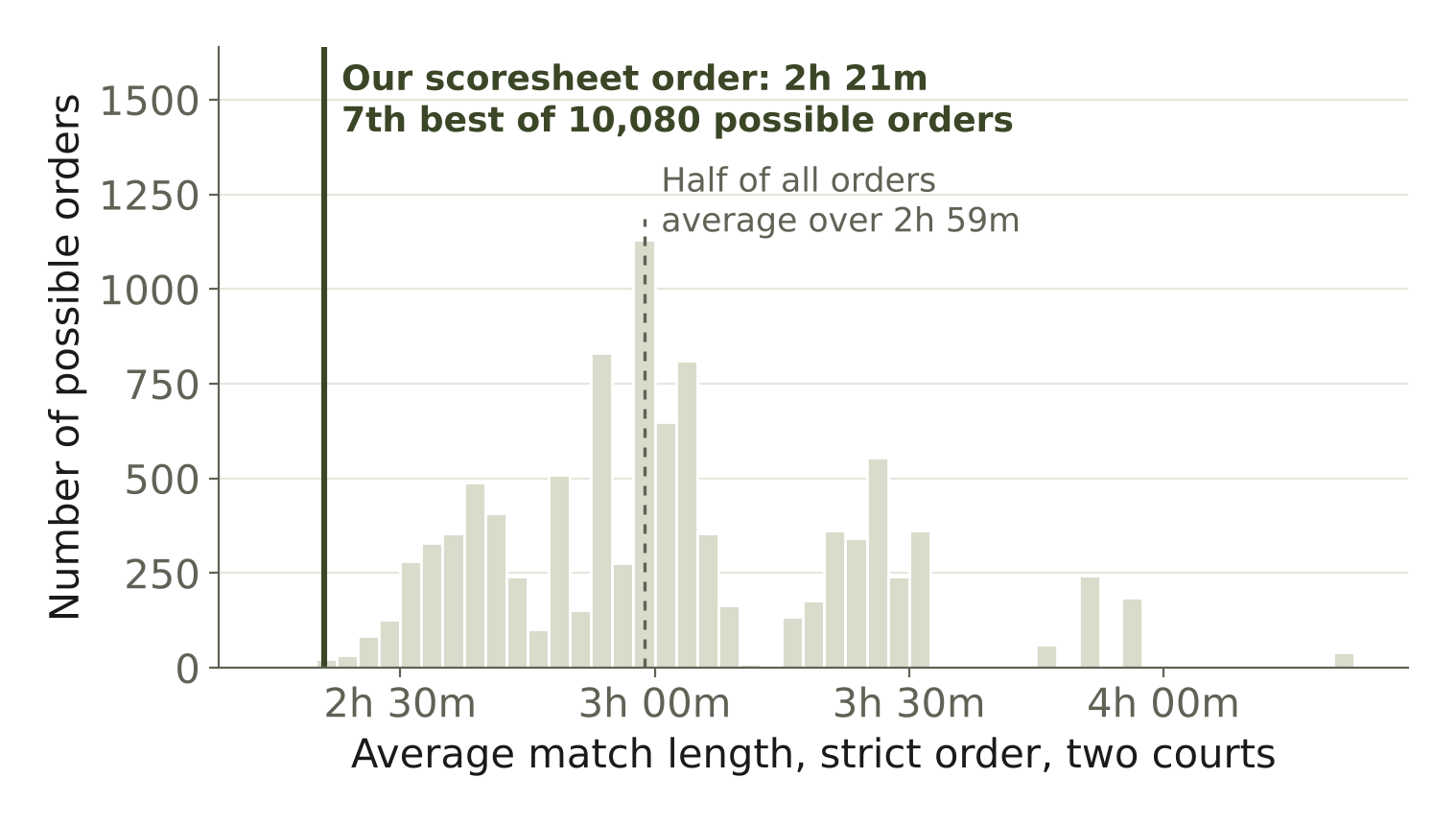
Our order came 7th. The best order we found saved only 34 seconds per match on average when re-tested on a fresh set of 100,000 matches, which is not worth changing for. A poorly designed order would be far worse: half of all possible orders average over 2h 59m, and the worst 4h 20m. What our order gets right is that no pair ever plays two rubbers in a row, so the next rubber is less likely to be held up.
With flexible play, our order does as well as any we re-tested: 2h 19m on average, against 2h 20m for the best strict-order alternative. With three courts our order is also within a few seconds of the best.
Does it depend on how long rubbers take?
We re-ran the two-court comparison with quicker, longer, more variable and less variable rubbers. The conclusion held every time.
| Scenario | Avg rubber | No difference | Flexible quicker | Flexible slower | Avg saving |
|---|---|---|---|---|---|
| Baseline | 29 min | 59% | 32% | 10% | 2.3 min |
| Quicker rubbers (2 games avg 20 min) | 25 min | 57% | 33% | 10% | 2.2 min |
| Longer rubbers (2 games avg 30 min) | 33 min | 60% | 30% | 10% | 2.4 min |
| Less variable (sd 4 min) | 28 min | 62% | 29% | 10% | 1.9 min |
| More variable (sd 10 min) | 31 min | 56% | 34% | 10% | 2.8 min |
| Fewer three-setters (10%) | 27 min | 60% | 31% | 10% | 2.0 min |
| More three-setters (40%) | 31 min | 58% | 32% | 10% | 2.4 min |
How the analysis was done
A Python program simulated 100,000 matches. Each rubber’s length was drawn at random, and each match was then played twice with the same rubber lengths: once in strict scoresheet order and once in flexible order.
- Scoresheet order: 1v1, 2v2, 3v3, 2v1, 3v2, 1v3, 3v1, 1v2, 2v3 (home pair v away pair).
- Strict order: rubbers start in that sequence. If the next rubber’s pairs aren’t both free, the free court waits.
- Flexible order: when a court is free, the earliest rubber on the scoresheet whose two pairs are free goes on.
- Rubber length: the first two games take 25 minutes on average (standard deviation 7, at least 12). One rubber in four goes to a third game of 13 minutes on average (standard deviation 5, at least 5). That gives 29 minutes per rubber on average, give or take 9.
- Simplifications: no time between rubbers for warm-ups or changing over, and pairs can go straight back on court.
- Checks: the program contains two independent versions of each rule: a step-by-step simulation and a fast version for large runs. Both give identical results on thousands of test matches.