
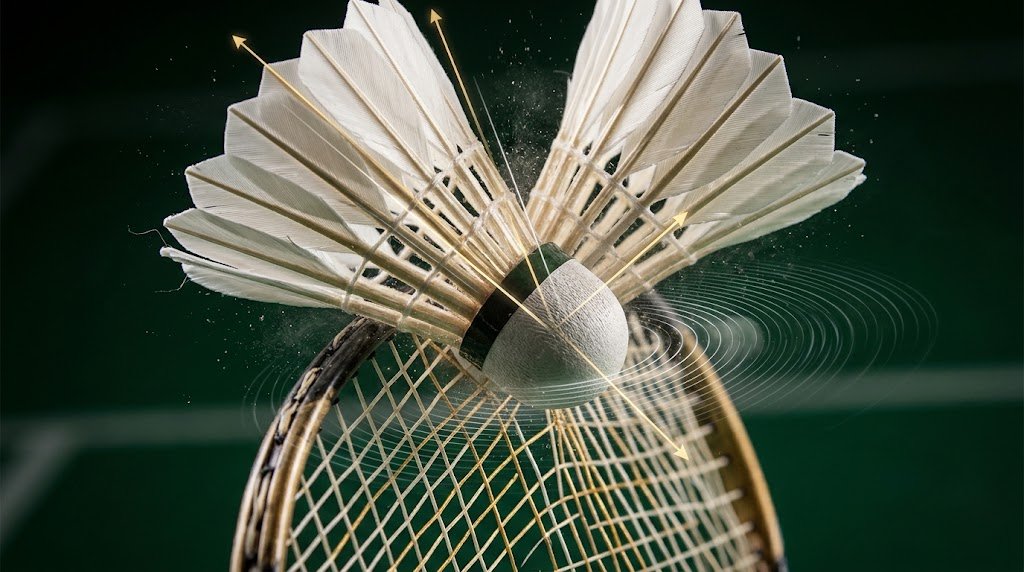
Does a heavier racket hit harder? Do tighter strings make the shuttle fly faster? And what do Yonex mean by “repulsion”?
Most of us have an opinion about rackets and strings, usually picked up from a shop, a team-mate or a YouTube review. We went to the sports-science research instead: lab studies of smashes by international players, high-speed video of the racket hitting the shuttle, and the physics of collisions.
The short version: your swing speed decides how fast the shuttle flies. Your racket and strings only nudge the result by a few per cent, and some of what “everyone knows” is the wrong way round.
The short answer
Racket speed is king. Swing 10% faster and the shuttle leaves about 10% faster. No string or frame comes close.
Light or heavy racket? It makes little difference to shuttle speed. You can swing a lighter racket faster, while a heavier one gives the shuttle a bigger shove at the same swing speed. The two effects cancel out. Choose on feel, comfort and how quickly you can get the racket into position.
Tighter strings make the shuttle slightly slower, not faster. They give a shorter contact and more control, which is why strong players accept the trade.
Thinner strings are a touch faster, but break sooner. Going from a 0.70 mm string to a 0.61 mm one is worth about 1%: roughly the same as dropping a pound or two of tension.
The sweet spot matters more than your gear. Even elite players’ normal scatter around the sweet spot costs them up to 5% of their speed.
“Repulsion” just means bounce. It’s the manufacturer’s word for how efficiently the strings and frame bounce the shuttle back.
Squeezing the grip at impact doesn’t add speed. The shuttle has gone before the shock reaches your hand. A relaxed grip helps you swing faster, and that’s what counts.
A millisecond of physics
Think of the hit as a collision between the shuttle and the bit of racket it touches. In that instant the racket behaves as if it weighed only about 40 grams, not 90, because it can rotate as well as move forwards. Physicists call this the racket’s effective mass.
A light object bouncing off a heavier, moving one can leave at up to twice the heavier object’s speed, if the bounce is perfectly springy. Real collisions lose some energy, mainly in squashing the feathers and cork, so the shuttle leaves at about 1.3 to 1.6 times the racket speed. In a lab study of 20 good regional-to-international players, rackets hit the shuttle at about 52 m/s and the shuttle left at about 80 m/s.
The forces are surprisingly large: around 50 to 60 kg-weight at the peak, accelerating the shuttle at several thousand g. The racket head loses roughly a fifth of its speed in the process. And it’s all over in a millisecond, before the shock has had time to travel down the shaft to your hand.
Strings, tension and “repulsion”
During the hit, two springs squash together: the string bed and the shuttle itself. The strings are very good springs and give back nearly all the energy they store. The shuttle is a poor one; its feathers and cork soak energy up.
Looser strings are the softer spring, so they take more of the squash and the shuttle takes less. More energy comes back, and the shuttle leaves faster. That’s the “trampoline effect”, and it’s why tighter strings give a slightly slower shuttle: by up to about 10% between roughly 20 and 34 lb in machine tests.
So why do strong players string tight? Tight strings shorten the contact. The racket is turning quickly through the hit, so a shorter contact means less change in the angle of the face while the shuttle is on the strings, and more precise placement. Real players also adapt: one study found the effect of tension on smash speed was different for beginners, club players and experts.
As for “repulsion” in Yonex’s string charts, the word comes from the Japanese 反発 (hanpatsu), as in the Japanese term for what physicists call the coefficient of restitution: a number from 0 to 1 measuring how bouncy a collision is. Yonex doesn’t publish how its 1–10 ratings are measured, so treat them as a guide to feel rather than a lab figure.
What about string thickness?
Badminton strings range from about 0.61 mm to 0.70 mm. That doesn’t sound like much, but the thinnest string has about a quarter less material than the thickest.
That difference matters in four ways:
- Slightly more speed. The strings the shuttle touches move with it and keep ringing after it has gone; that vibration is wasted energy. Thinner strings weigh less, so less is wasted. Our estimate is a gain of about 1%.
- Not much softer. You might expect a thinner string to make a softer, bouncier bed, but at normal tensions the stiffness of the bed is set almost entirely by the tension. Thickness changes it by only a few per cent.
- A crisper sound. A thinner string vibrates at a higher pitch, about 15% higher, or two and a half semitones. That sharp “ping” is why Yonex sells its thinnest strings on their hitting sound, and it may be part of why they feel more powerful.
- Shorter life. At the same tension a thin string is under about 30% more stress, and it has less material to wear through where the strings cross. Expect to restring more often.
| Yonex string | Gauge (mm) | Material† | Pitch* |
|---|---|---|---|
| Aerosonic | 0.61 | 76% | 1,290 Hz |
| BG66 Ultimax | 0.65 | 86% | 1,210 Hz |
| BG80 (club stock) | 0.68 | 94% | 1,160 Hz |
| BG65 Ti (club default) | 0.70 | 100% | 1,120 Hz |
†Amount of string compared with a 0.70 mm string. *Our estimate for a single string at 24 lb; the real string bed rings at different frequencies, but in the same order. Highlighted strings are stocked by the club restringing service.
Light or heavy, stiff or flexible?
Weight and balance
A team at Loughborough University gave 20 experienced players five rackets of the same weight, with the balance shifted step by step towards the head. The head-heavy rackets were swung more slowly, about 0.7 m/s slower for each step, but the shuttle came off just as fast. A heavier head gives the shuttle a bigger shove for the same swing, and that made up for the slower swing. Because the shuttle is so light, racket weight simply matters less in badminton than in tennis.
Flex
As you swing, the shaft bends back and then springs forward. Hit at the right moment and that spring adds a few per cent to racket speed; one study measured up to 13% in a full smash. Good players time their hit to catch the shaft as it straightens. A flexible racket gives more of this boost but makes timing more critical; a stiff one gives less boost and more consistency.
The sweet spot
In a study of 65 international players, where the shuttle hit the strings explained about a quarter of the differences in their smash speeds. Hit towards the tip, or a few centimetres to the side, and the racket behaves as if it were lighter at that point, so the shuttle leaves slower and the racket twists in your hand.
The bottom line
If you want a faster smash, work on racket-head speed and clean contact first. Then choose a racket that feels quick in your hand, and a string and tension that suit your control. The equipment adds the last few per cent, not the first fifty.
Where the numbers come from
- Racket and shuttle speeds: Towler, Mitchell & King (2023), Loughborough University: 20 players, five rackets of different balance.
- Sweet spot: McErlain-Naylor and colleagues (2020): 2,386 smashes by 65 international players.
- String tension: machine tests reported in Sensors (2023) and at the 2013 International Conference on Biomechanics in Sports.
- Shaft flex: Maxine Kwan’s PhD thesis (Aalborg University, 2010) and a 2024 study of rigid and flexible rackets.
- Contact time: high-speed video by Cohen and colleagues, “The physics of badminton” (New Journal of Physics, 2015).
- Effective mass, string thickness and pitch: our own calculations from standard collision physics, using typical racket and string figures.
Want the equations? The full technical write-up, with derivations and 25 references, is available as a PDF.
Download the technical write-up (PDF)