Category: News

  • What really makes the shuttle fly?

    What really makes the shuttle fly?

    Does a heavier racket hit harder? Do tighter strings make the shuttle fly faster? And what do Yonex mean by “repulsion”?

    Most of us have an opinion about rackets and strings, usually picked up from a shop, a team-mate or a YouTube review. We went to the sports-science research instead: lab studies of smashes by international players, high-speed video of the racket hitting the shuttle, and the physics of collisions.

    The short version: your swing speed decides how fast the shuttle flies. Your racket and strings only nudge the result by a few per cent, and some of what “everyone knows” is the wrong way round.

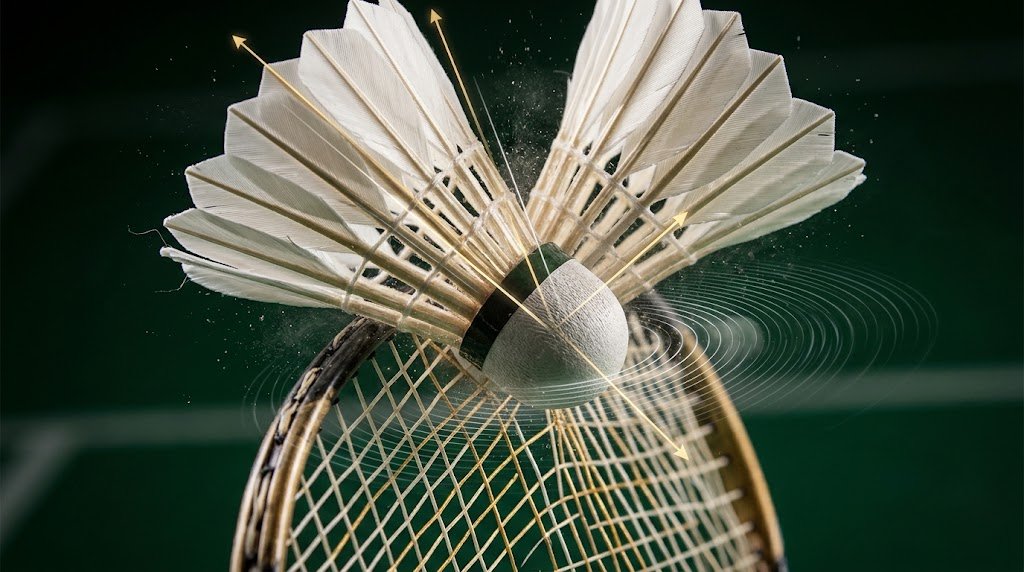
    1 mshow long the shuttle is on the strings during a smash
    1.5×the shuttle leaves about one and a half times faster than the racket head
    up to 10%slower shuttle with strings at 34 lb than at 20 lb

    The short answer

    Racket speed is king. Swing 10% faster and the shuttle leaves about 10% faster. No string or frame comes close.

    Light or heavy racket? It makes little difference to shuttle speed. You can swing a lighter racket faster, while a heavier one gives the shuttle a bigger shove at the same swing speed. The two effects cancel out. Choose on feel, comfort and how quickly you can get the racket into position.

    Tighter strings make the shuttle slightly slower, not faster. They give a shorter contact and more control, which is why strong players accept the trade.

    Thinner strings are a touch faster, but break sooner. Going from a 0.70 mm string to a 0.61 mm one is worth about 1%: roughly the same as dropping a pound or two of tension.

    The sweet spot matters more than your gear. Even elite players’ normal scatter around the sweet spot costs them up to 5% of their speed.

    “Repulsion” just means bounce. It’s the manufacturer’s word for how efficiently the strings and frame bounce the shuttle back.

    Squeezing the grip at impact doesn’t add speed. The shuttle has gone before the shock reaches your hand. A relaxed grip helps you swing faster, and that’s what counts.

    Your swing beats every equipment change Change in shuttle speed, smash, per cent Swing 10% faster +10 Flexible shaft, well timed +4 to +6 Thinner strings (0.70 → 0.61 mm) ≈ +1 (estimate) Head-heavy racket (as swung) no measurable change Normal off-centre hits up to −5 Tighter strings (20 → 34 lb) up to −10 0 Your swing beats every equipment change Swing 10% faster: +10%Flexible shaft, well timed: +4 to +6%Thinner strings, 0.70 → 0.61 mm: about +1% (estimate)Head-heavy racket, as swung: no measurable changeNormal off-centre hits: up to −5%Tighter strings, 20 → 34 lb: up to −10%
    Green bars speed the shuttle up; gold bars slow it down. Sizes come from the studies listed at the end; the string-thickness figure is our own estimate.

    A millisecond of physics

    Think of the hit as a collision between the shuttle and the bit of racket it touches. In that instant the racket behaves as if it weighed only about 40 grams, not 90, because it can rotate as well as move forwards. Physicists call this the racket’s effective mass.

    A light object bouncing off a heavier, moving one can leave at up to twice the heavier object’s speed, if the bounce is perfectly springy. Real collisions lose some energy, mainly in squashing the feathers and cork, so the shuttle leaves at about 1.3 to 1.6 times the racket speed. In a lab study of 20 good regional-to-international players, rackets hit the shuttle at about 52 m/s and the shuttle left at about 80 m/s.

    The shuttle leaves 1.5 times faster than the racket Average smash, 20 regional-to-international players Racket head 52 m/s (187 km/h) Shuttle 80 m/s (290 km/h) The shuttle leaves 1.5 times faster than the racket Racket head: 52 m/s (187 km/h) Shuttle: 80 m/s (290 km/h)
    Source: Towler, Mitchell & King, Loughborough University (Scientific Reports, 2023).

    The forces are surprisingly large: around 50 to 60 kg-weight at the peak, accelerating the shuttle at several thousand g. The racket head loses roughly a fifth of its speed in the process. And it’s all over in a millisecond, before the shock has had time to travel down the shaft to your hand.

    Strings, tension and “repulsion”

    During the hit, two springs squash together: the string bed and the shuttle itself. The strings are very good springs and give back nearly all the energy they store. The shuttle is a poor one; its feathers and cork soak energy up.

    Looser strings are the softer spring, so they take more of the squash and the shuttle takes less. More energy comes back, and the shuttle leaves faster. That’s the “trampoline effect”, and it’s why tighter strings give a slightly slower shuttle: by up to about 10% between roughly 20 and 34 lb in machine tests.

    So why do strong players string tight? Tight strings shorten the contact. The racket is turning quickly through the hit, so a shorter contact means less change in the angle of the face while the shuttle is on the strings, and more precise placement. Real players also adapt: one study found the effect of tension on smash speed was different for beginners, club players and experts.

    As for “repulsion” in Yonex’s string charts, the word comes from the Japanese 反発 (hanpatsu), as in the Japanese term for what physicists call the coefficient of restitution: a number from 0 to 1 measuring how bouncy a collision is. Yonex doesn’t publish how its 1–10 ratings are measured, so treat them as a guide to feel rather than a lab figure.

    What about string thickness?

    Badminton strings range from about 0.61 mm to 0.70 mm. That doesn’t sound like much, but the thinnest string has about a quarter less material than the thickest.

    A quarter less string String cross-sections, enlarged and drawn to scale 0.61 mm e.g. Aerosonic 0.70 mm e.g. BG65 Ti 24% less material A quarter less string Cross-sections, enlarged, to scale 0.61 mm Aerosonic 0.70 mm BG65 Ti 24% less material
    Area grows with the square of the diameter, so a small difference in gauge is a bigger difference in material.

    That difference matters in four ways:

    • Slightly more speed. The strings the shuttle touches move with it and keep ringing after it has gone; that vibration is wasted energy. Thinner strings weigh less, so less is wasted. Our estimate is a gain of about 1%.
    • Not much softer. You might expect a thinner string to make a softer, bouncier bed, but at normal tensions the stiffness of the bed is set almost entirely by the tension. Thickness changes it by only a few per cent.
    • A crisper sound. A thinner string vibrates at a higher pitch, about 15% higher, or two and a half semitones. That sharp “ping” is why Yonex sells its thinnest strings on their hitting sound, and it may be part of why they feel more powerful.
    • Shorter life. At the same tension a thin string is under about 30% more stress, and it has less material to wear through where the strings cross. Expect to restring more often.
    Yonex stringGauge (mm)Material†Pitch*
    Aerosonic0.6176%1,290 Hz
    BG66 Ultimax0.6586%1,210 Hz
    BG80 (club stock)0.6894%1,160 Hz
    BG65 Ti (club default)0.70100%1,120 Hz

    †Amount of string compared with a 0.70 mm string. *Our estimate for a single string at 24 lb; the real string bed rings at different frequencies, but in the same order. Highlighted strings are stocked by the club restringing service.

    Light or heavy, stiff or flexible?

    Weight and balance

    A team at Loughborough University gave 20 experienced players five rackets of the same weight, with the balance shifted step by step towards the head. The head-heavy rackets were swung more slowly, about 0.7 m/s slower for each step, but the shuttle came off just as fast. A heavier head gives the shuttle a bigger shove for the same swing, and that made up for the slower swing. Because the shuttle is so light, racket weight simply matters less in badminton than in tennis.

    Flex

    As you swing, the shaft bends back and then springs forward. Hit at the right moment and that spring adds a few per cent to racket speed; one study measured up to 13% in a full smash. Good players time their hit to catch the shaft as it straightens. A flexible racket gives more of this boost but makes timing more critical; a stiff one gives less boost and more consistency.

    The sweet spot

    Off-centre, the racket hits like a lighter one Effective mass of a 90 g racket at different points on the strings 35 g 5 cm towards the tip 31 g 4 cm to the side 39 g 2 cm to the side 53 g 5 cm towards the handle 42 gcentre Off-centre, the racket hits like a lighter one 35 g5 cm towards the tip 31 g4 cm to the side 39 g2 cm to the side 42 gcentre 53 g5 cm towards the handle
    Our calculation for a typical racket. A lighter effective mass means a slower shuttle, and hits to the side also make the racket twist.

    In a study of 65 international players, where the shuttle hit the strings explained about a quarter of the differences in their smash speeds. Hit towards the tip, or a few centimetres to the side, and the racket behaves as if it were lighter at that point, so the shuttle leaves slower and the racket twists in your hand.

    The bottom line

    If you want a faster smash, work on racket-head speed and clean contact first. Then choose a racket that feels quick in your hand, and a string and tension that suit your control. The equipment adds the last few per cent, not the first fifty.

    Where the numbers come from

    • Racket and shuttle speeds: Towler, Mitchell & King (2023), Loughborough University: 20 players, five rackets of different balance.
    • Sweet spot: McErlain-Naylor and colleagues (2020): 2,386 smashes by 65 international players.
    • String tension: machine tests reported in Sensors (2023) and at the 2013 International Conference on Biomechanics in Sports.
    • Shaft flex: Maxine Kwan’s PhD thesis (Aalborg University, 2010) and a 2024 study of rigid and flexible rackets.
    • Contact time: high-speed video by Cohen and colleagues, “The physics of badminton” (New Journal of Physics, 2015).
    • Effective mass, string thickness and pitch: our own calculations from standard collision physics, using typical racket and string figures.

    Want the equations? The full technical write-up, with derivations and 25 references, is available as a PDF.

    Download the technical write-up (PDF)

    ← All club news

  • Would 15-point games change the winner? We replayed 824 games to find out.

    Would 15-point games change the winner? We replayed 824 games to find out.

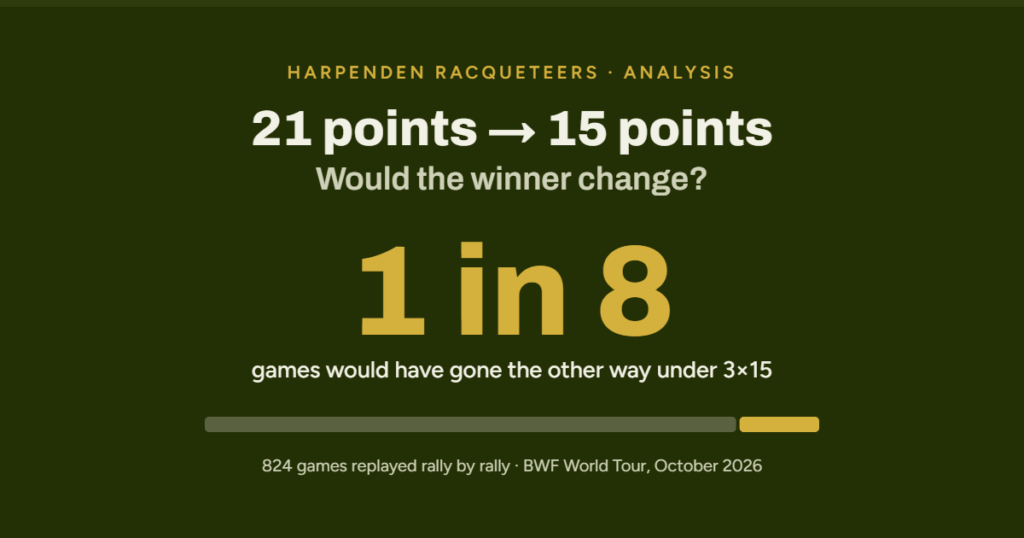
    From 4 January 2027, international badminton switches from three games to 21 to three games to 15. So how often would the shorter game have produced a different winner? We replayed every rally from two BWF tournaments this week to find out.

    1 in 8games would have been won by the other side
    45%of games won by just two points would have flipped
    0games won by six or more points changed hands
    30%fewer rallies per game on average

    What’s changing

    Under the new BWF rules, each game is played to 15 points. At 14-all you need a two-point lead, with a cap at 21, so at 20-all the next point wins. Matches are still best of three, rally-point scoring stays, and the mid-game interval moves to 8 points. National associations and clubs can choose to keep 21-point scoring for domestic play.

    How we tested it

    BWF’s Match Centre logs the score after every rally while a tournament is live. We collected the full rally-by-rally record for 352 completed matches (824 games) from the YONEX French Open (Super 750) and the POLYTRON Kudus Indonesia Masters (Super 100), 20–24 October 2026, covering qualifying through to the semi-finals in all five events.

    For each game we ran the same rallies through the 15-point rules and checked whether the same side would still have won. Retirements, and a handful of matches where BWF’s own point log didn’t add up to the official score, were left out.

    One game in eight changes hands

    Of 824 games, 108 (13%) would have gone to the other side. These are games where one side got to 15 first but was then overhauled before 21.

    The closer the game, the more likely the result flips

    Share of games that would change winner, by the final winning margin under 21-point scoring

    0%10%20%30%40%50%2-point winning margin: 75 of 167 games changed winner (45%)2-point winning margin: 75 of 167 games changed winner (45%)45%2 pts167 games3-point winning margin: 22 of 91 games changed winner (24%)3-point winning margin: 22 of 91 games changed winner (24%)24%3 pts91 games4–5-point winning margin: 11 of 176 games changed winner (6%)4–5-point winning margin: 11 of 176 games changed winner (6%)6%4–5 pts176 games6–9-point winning margin: 0 of 248 games changed winner (0%)0%6–9 pts248 games10+-point winning margin: 0 of 142 games changed winner (0%)0%10+ pts142 games
    Close finishes include deuce games (e.g. 22–20, 30–29). Hover over a bar for the counts.

    It’s almost entirely a close-game story. Nearly half of games won by two points would have been lost at 15, and a quarter of those won by three. Once the winning margin reached six points, not a single game changed hands: if you were that far ahead at the end, you were already ahead at 15.

    Men’s doubles is most affected

    Games that would change winner, by event

    Share of games where the side leading at 15 lost at 21

    Men’s doublesMen's doubles: 30 of 159 games changed winner (18.9%)Men's doubles: 30 of 159 games changed winner (18.9%)19% (30/159)Women’s doublesWomen's doubles: 19 of 145 games changed winner (13.1%)Women's doubles: 19 of 145 games changed winner (13.1%)13% (19/145)Men’s singlesMen's singles: 23 of 194 games changed winner (11.9%)Men's singles: 23 of 194 games changed winner (11.9%)12% (23/194)Women’s singlesWomen's singles: 18 of 160 games changed winner (11.2%)Women's singles: 18 of 160 games changed winner (11.2%)11% (18/160)Mixed doublesMixed doubles: 18 of 166 games changed winner (10.8%)Mixed doubles: 18 of 166 games changed winner (10.8%)11% (18/166)
    Counts in brackets: games that flipped / games played.

    Men’s doubles stands out at almost one game in five, perhaps reflecting how quickly momentum swings in the fastest discipline. The other four events are bunched together at 11–13%. With one week’s data, the gaps between those four are well within chance.

    Picture it: an 8–15 deficit turned into a 23–21 win

    Rally by rally: a comeback the new scoring would have cut short

    Mixed doubles, first round, Kudus Indonesia Masters, first game

    051015203×15: game over here3×21: play went onPair A 23won at 21 ptsPair B 21won at 15 pts010203040Rallies played
    Olive solid line: Pair A (eventual winners at 21 points). Gold dashed line: Pair B. The shaded area is play that would never happen under 15-point scoring.

    Pair B raced to 15–8 after 23 rallies: game over under the new rules. Under the current rules Pair A had six more points of runway, won 15 of the next 21 rallies and took the game 23–21. Comebacks like this are exactly what the shorter game will cut out.

    What about whole matches?

    Match outcomes when the same rallies are scored to 15

    352 matches, ignoring changes to who serves first

    Same winner: 279 of 352 (79%)Would need a decider: 54 of 352 (15%)Different winner: 19 of 352 (5%)
    79% same winner (279)15% would need a decider (54)5% different winner (19)
    A match “needs a decider” when the 15-point results split the games 1–1 but only two games were actually played, so there are no real rallies to settle it.

    Because a match needs two games, one flipped game often doesn’t change the overall result. 19 matches (5%) would have had a different winner outright. A further 54 (15%) would have gone to a third game that was never played. So somewhere between about 1 in 20 and 1 in 5 match results could change, depending on how those deciders went.

    A pinch of salt. This replays real rallies under new rules, but players won’t play a 15-point game the same way. Expect faster starts, earlier risks and different use of the interval. It also covers one week of top-level badminton, so treat the event-by-event numbers as a first look rather than the final word.

    What it means on court

    • Starts matter more. There’s less time to play yourself in: a slow opening is much harder to recover from.
    • Close games get more random. If a game is going to finish within two or three points, the shorter format makes the result noticeably more of a coin toss.
    • Matches get shorter. Games averaged 37 rallies under 21-point scoring and would have averaged 26 under 15, about 30% fewer.

    Fancy testing it for yourself? Try a few games to 15 at club night and let us know how it feels.

    Sources: BWF, Key Changes Under the 3×15 Scoring System (26 April 2026); rally data from the BWF Match Centre, YONEX French Open 2026 and POLYTRON Kudus Indonesia Masters 2026, 20–24 October 2026. Analysis by Harpenden Racqueteers.

  • Summer 2026 tournament winners

    Summer 2026 tournament winners

    Congratulations to the following winners of our third annual tournament, and thanks to John and Gavin for organising.

  • Should we stick to the scoresheet order?

    Should we stick to the scoresheet order?

    When a court comes free and the next rubber on the scoresheet can’t start because one of its pairs is still playing, should you wait for them, or put on another rubber whose pairs are ready?

    This question comes up in Men’s and Mixed matches, where three pairs from each side play nine rubbers. To answer it we simulated 100,000 matches. We also looked at what happens with three courts, whether our scoresheet order is a good one, and how much the answers depend on how long rubbers last.

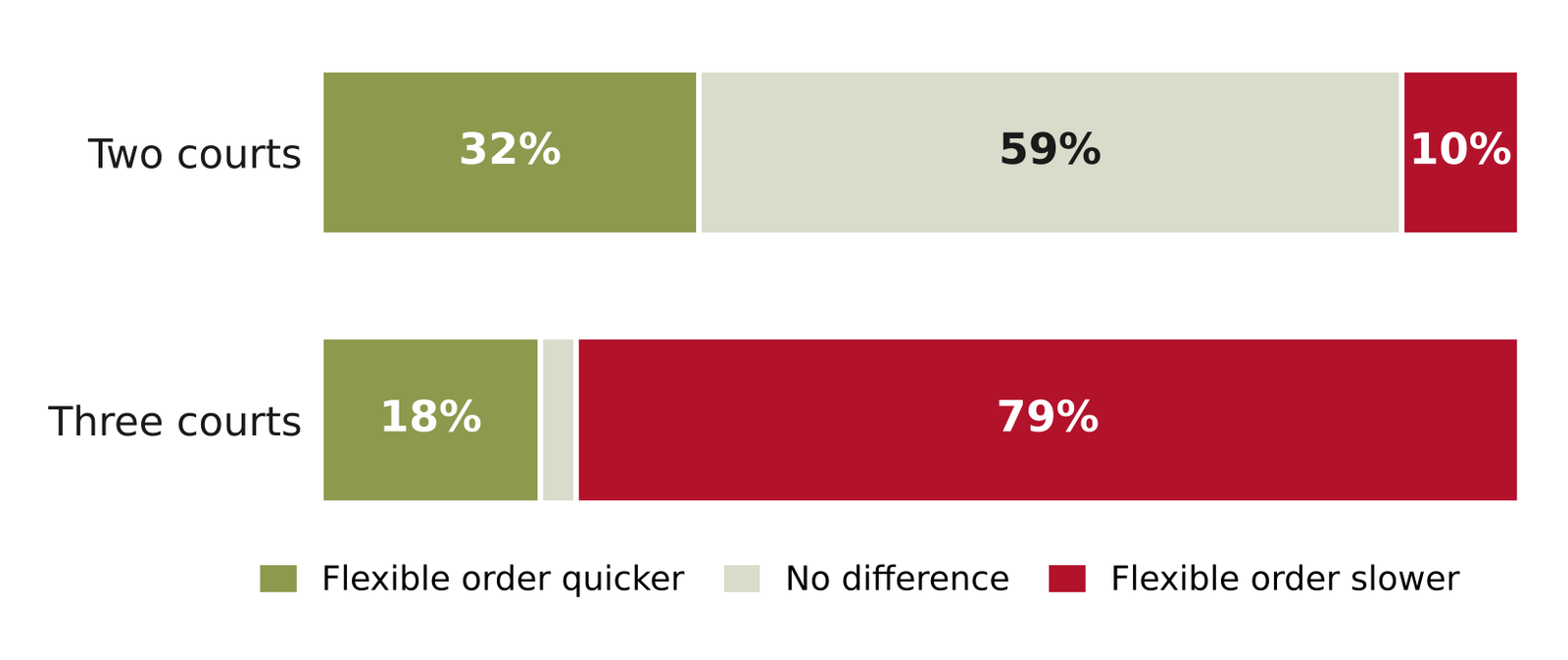
    59%
    of two-court matches finish at the same time either way
    32%
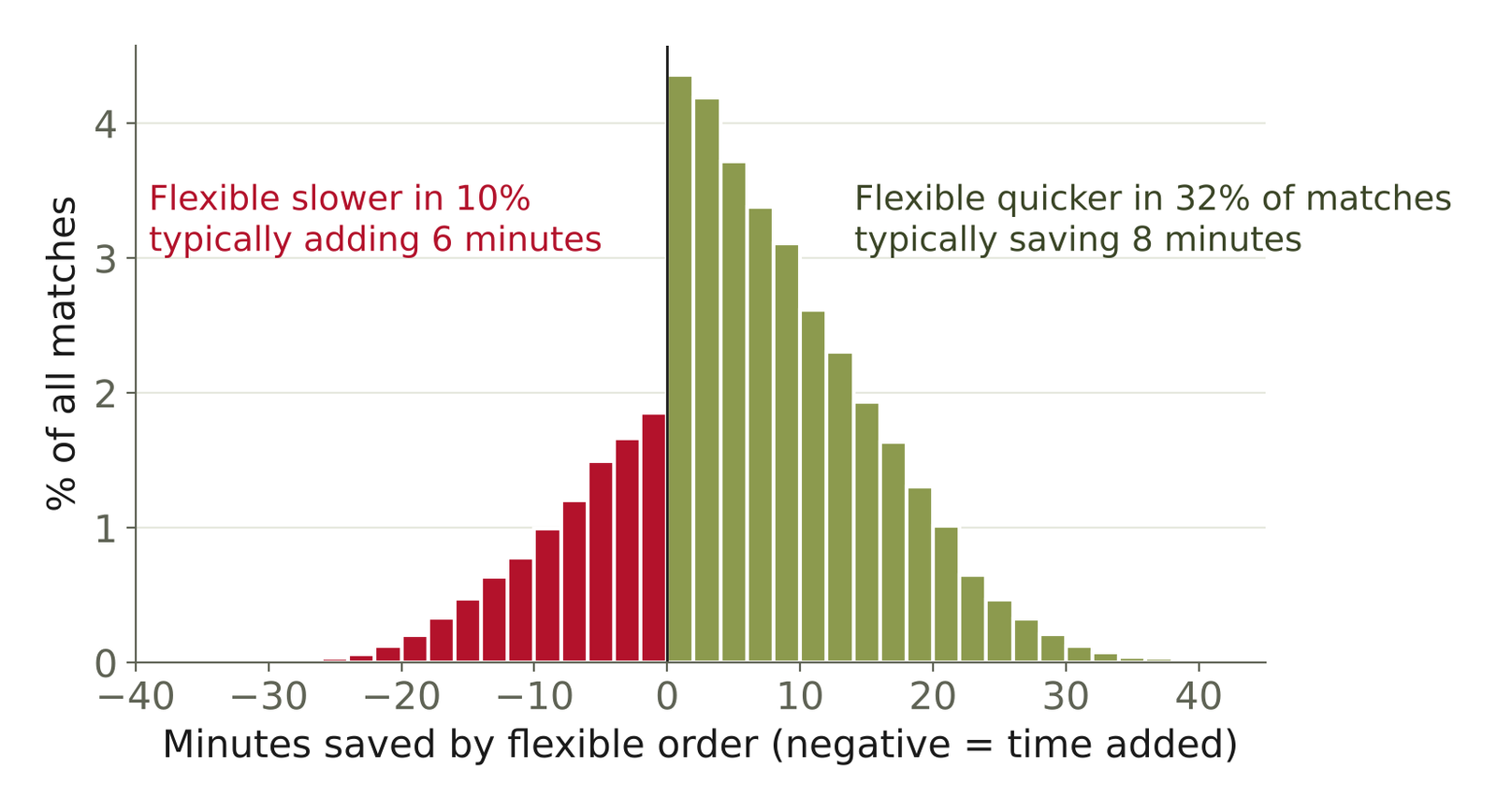
    finish sooner if you play the next available rubber, typically by about 8 minutes
    10%
    finish later, typically by about 6 minutes

    The short answer

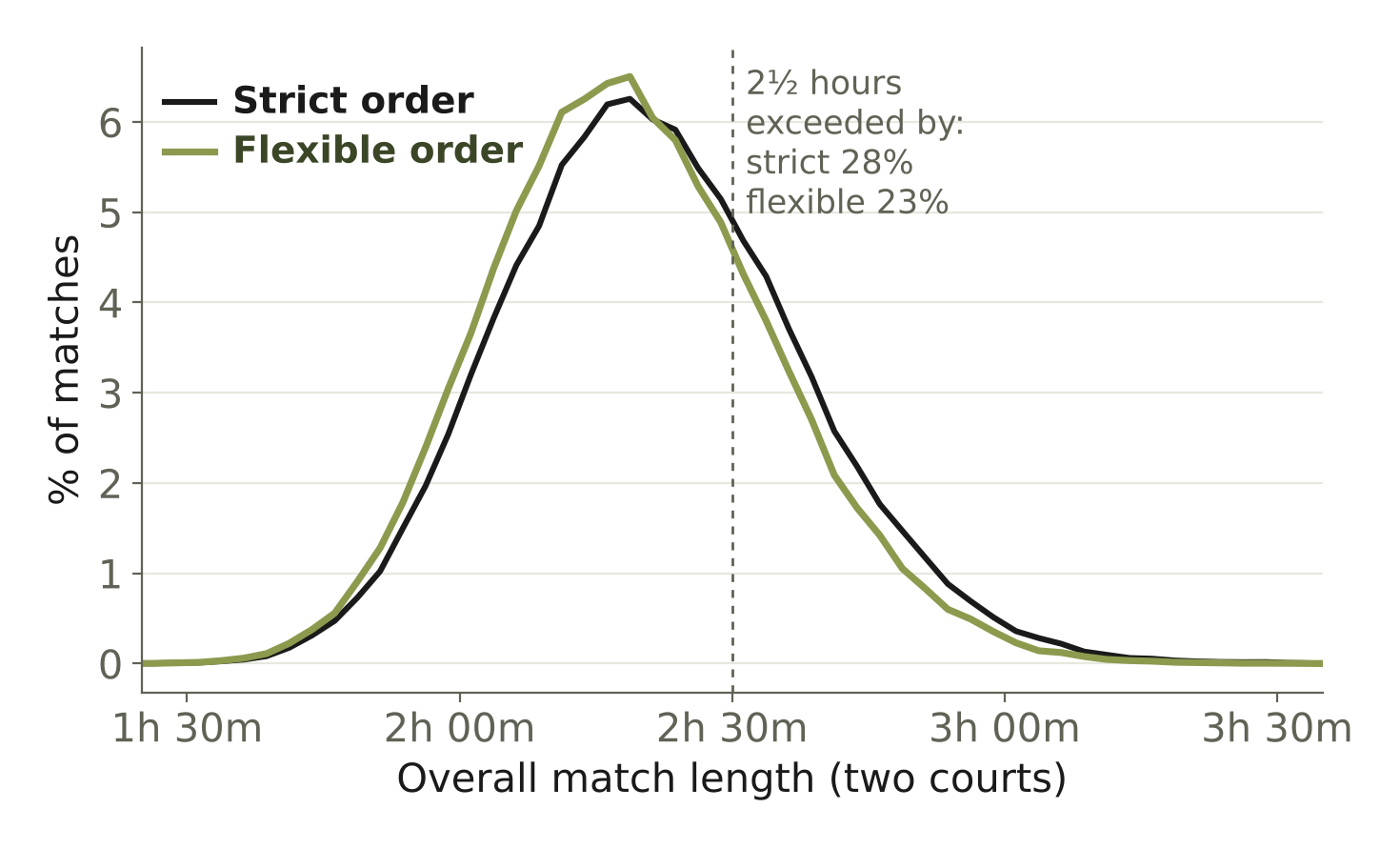
    With two courts, be flexible. If the next rubber can’t start, put on the next one down the scoresheet whose pairs are both free. Most of the time it makes no difference. When it does, it usually helps. On average a match takes 2h 21m in strict order and 2h 19m in flexible order. The chance of a match running past two and a half hours falls from 28% to 23%.

    With three courts, stick to the scoresheet. Here jumping ahead backfires: flexible order made the match longer in 79% of simulations, by 8 minutes on average.

    Our scoresheet order itself is already among the best of the 10,080 possible orders, so there is no reason to change it.

    How much time does it save?

    The chart shows the time saved by flexible order in every two-court match where the two approaches gave different results. Bars to the right (olive) are matches that finished sooner; bars to the left (red) are matches that finished later. The matches where it made no difference (59% of them) are left out.

    Across all matches, including those with no difference, the average saving is a modest 2.3 minutes. The benefit is not that every match is a little quicker. About one match in three finishes around ten minutes sooner.

    Why it happens: three real examples

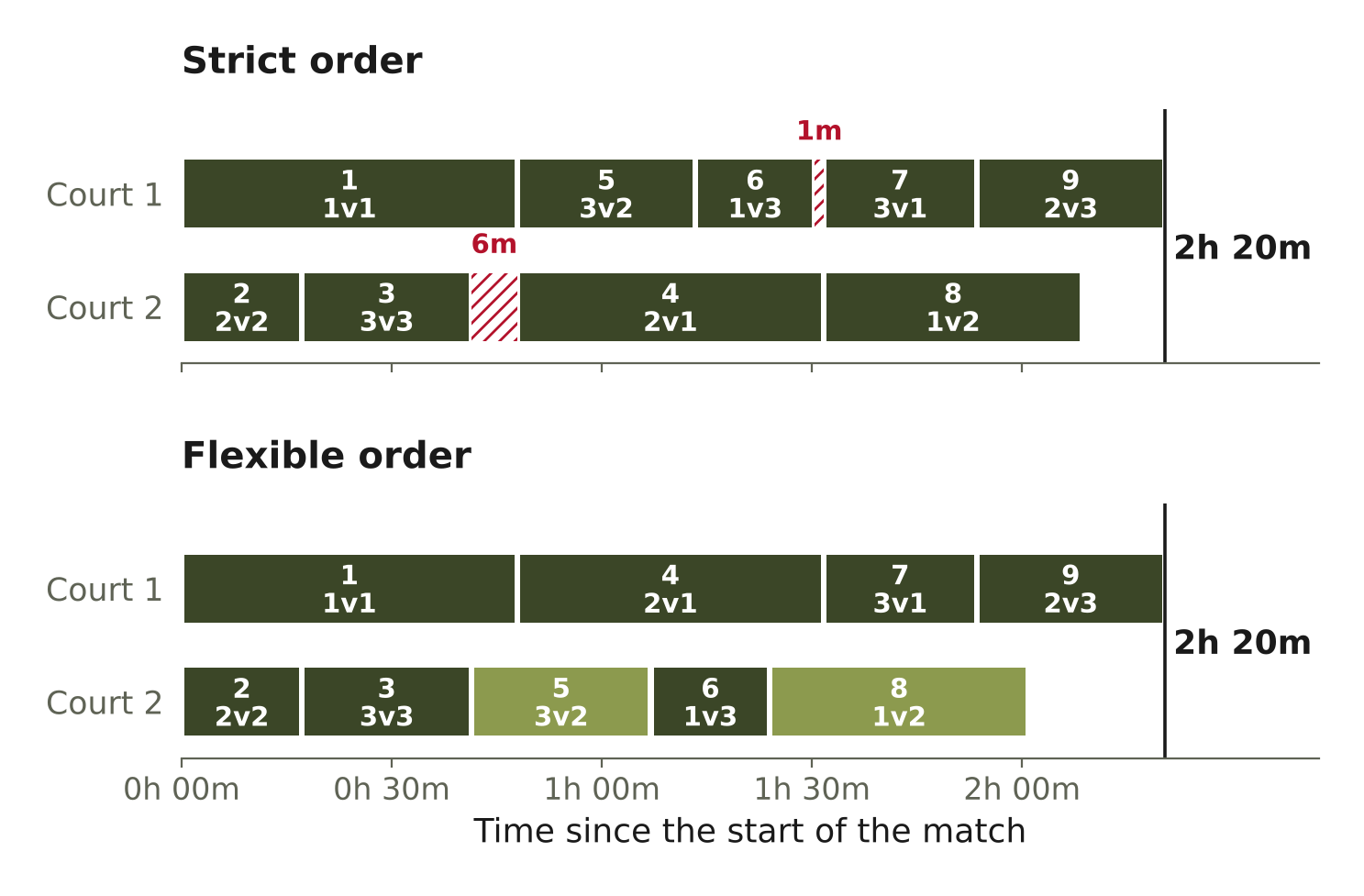
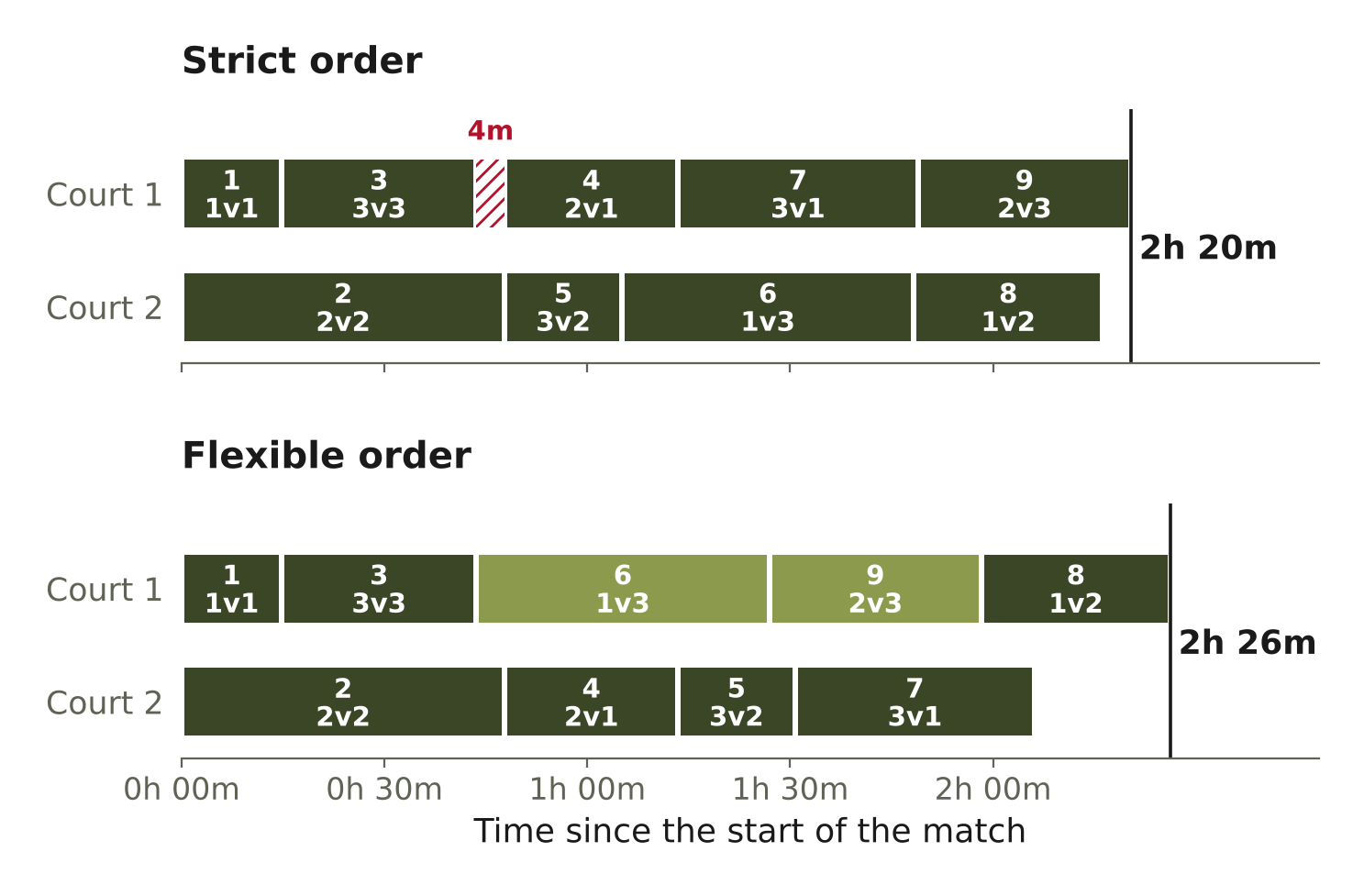
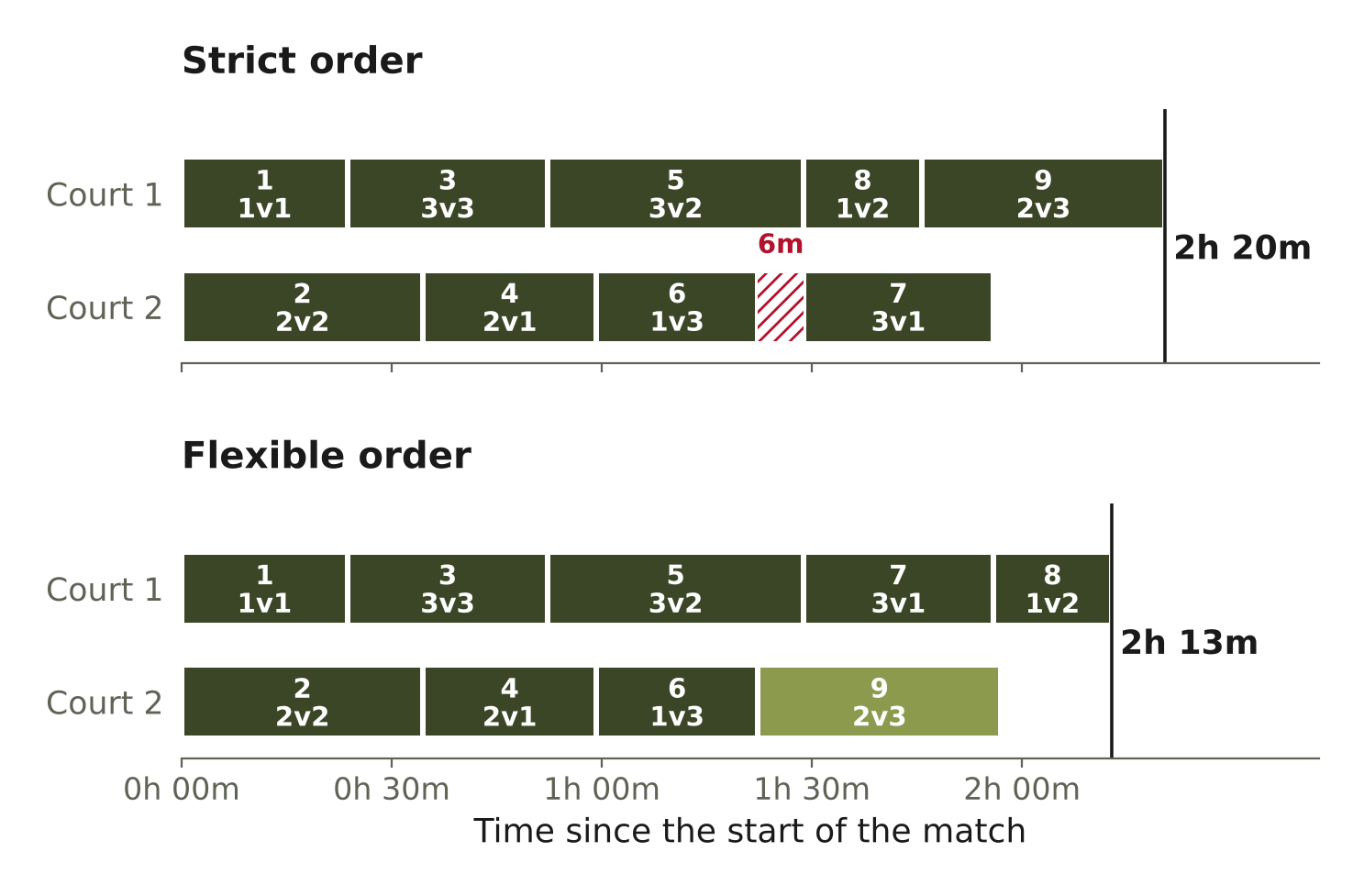
    Each picture below follows one simulated match from the first shuttle to the last. Each block is a rubber, labelled with its scoresheet number and the home pair against the away pair. Red hatching shows a court standing empty. Light olive marks a rubber that flexible order played earlier than the scoresheet says. Each example uses the same rubber lengths under both rules.

    1. Flexible order fills the gap, but the match ends at the same time

    2. Flexible order makes the match longer

    3. Flexible order makes the match shorter

    What if we have three courts?

    With three courts the picture reverses. In strict order a match averages 1h 49m; in flexible order it averages 1h 58m. Flexible order is slower in 79% of matches.

    The scoresheet is built in three rounds of three rubbers, and within each round every pair plays exactly once. With three courts, each round can go on at once. Grabbing whichever rubber is ready first breaks up those rounds. Soon every rubber left needs at least one pair that is still playing, so a court sits empty anyway.

    Is our scoresheet order a good one?

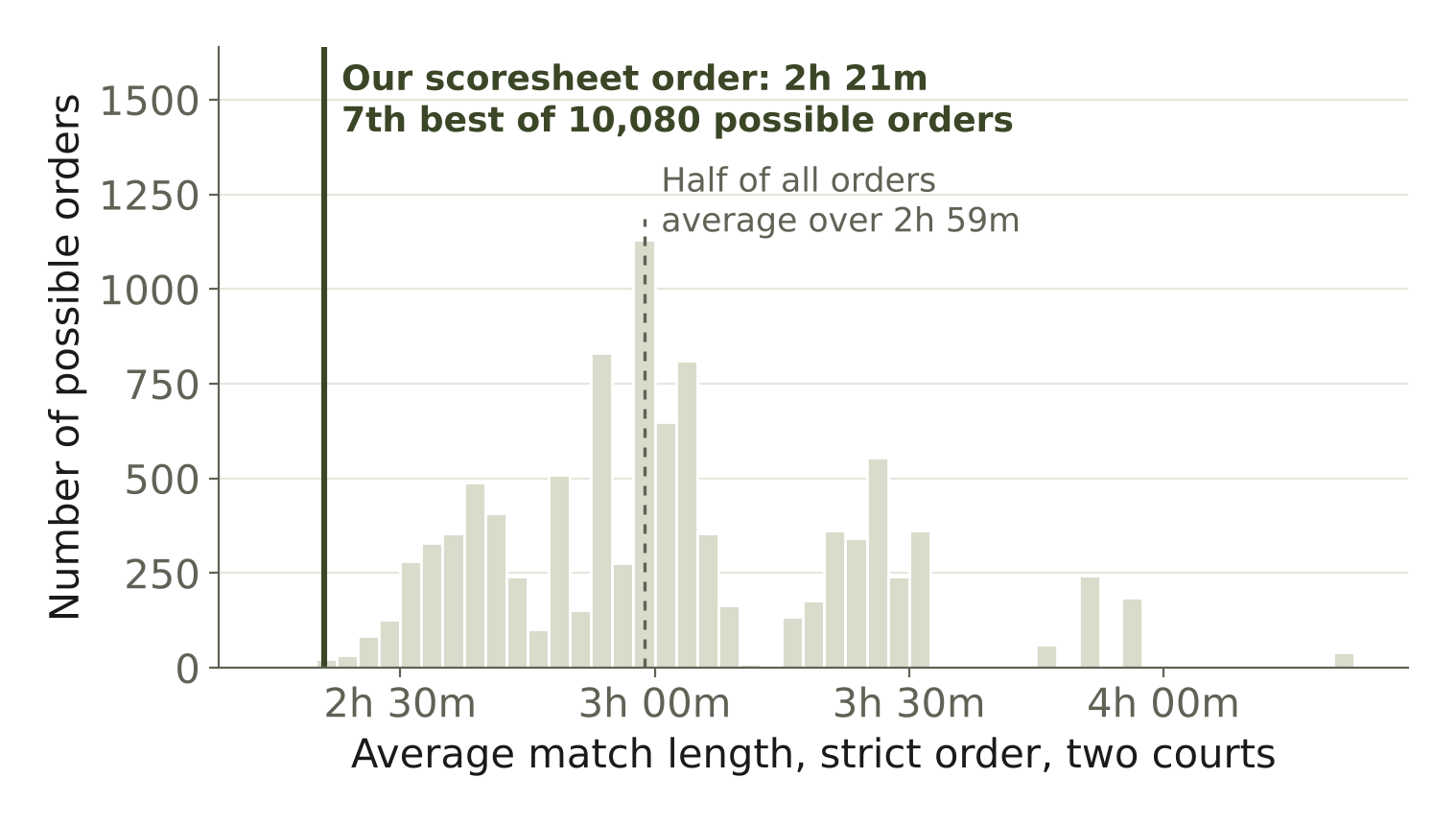
    There are 10,080 genuinely different ways to order the nine rubbers. We tested every one with two courts and strict order.

    Our order came 7th. The best order we found saved only 34 seconds per match on average when re-tested on a fresh set of 100,000 matches, which is not worth changing for. A poorly designed order would be far worse: half of all possible orders average over 2h 59m, and the worst 4h 20m. What our order gets right is that no pair ever plays two rubbers in a row, so the next rubber is less likely to be held up.

    With flexible play, our order does as well as any we re-tested: 2h 19m on average, against 2h 20m for the best strict-order alternative. With three courts our order is also within a few seconds of the best.

    Does it depend on how long rubbers take?

    We re-ran the two-court comparison with quicker, longer, more variable and less variable rubbers. The conclusion held every time.

    ScenarioAvg rubberNo differenceFlexible quickerFlexible slowerAvg saving
    Baseline29 min59%32%10%2.3 min
    Quicker rubbers (2 games avg 20 min)25 min57%33%10%2.2 min
    Longer rubbers (2 games avg 30 min)33 min60%30%10%2.4 min
    Less variable (sd 4 min)28 min62%29%10%1.9 min
    More variable (sd 10 min)31 min56%34%10%2.8 min
    Fewer three-setters (10%)27 min60%31%10%2.0 min
    More three-setters (40%)31 min58%32%10%2.4 min

    How the analysis was done

    A Python program simulated 100,000 matches. Each rubber’s length was drawn at random, and each match was then played twice with the same rubber lengths: once in strict scoresheet order and once in flexible order.

    • Scoresheet order: 1v1, 2v2, 3v3, 2v1, 3v2, 1v3, 3v1, 1v2, 2v3 (home pair v away pair).
    • Strict order: rubbers start in that sequence. If the next rubber’s pairs aren’t both free, the free court waits.
    • Flexible order: when a court is free, the earliest rubber on the scoresheet whose two pairs are free goes on.
    • Rubber length: the first two games take 25 minutes on average (standard deviation 7, at least 12). One rubber in four goes to a third game of 13 minutes on average (standard deviation 5, at least 5). That gives 29 minutes per rubber on average, give or take 9.
    • Simplifications: no time between rubbers for warm-ups or changing over, and pairs can go straight back on court.
    • Checks: the program contains two independent versions of each rule: a step-by-step simulation and a fast version for large runs. Both give identical results on thousands of test matches.
  • Newsletter: shuttle speed decay

    Newsletter: shuttle speed decay

    The importance of lifting to the rear of the court…

    The linked research article shows the physics behind how much a shuttle slows down when smashed – its speed halves for every 3.35m it travels!

    Eric Collet 2026 Phys. Scr. 101 125007

    Graph of shuttle speed falling with distance across a badminton court

    The time-of-flight increases by about 50% for a smash from a range of 11.5m compared to a range of 10m.

    Also, since nylon shuttles deform more when smashed, their speed is much greater than feather shuttles.

  • Christmas 2025 tournament winners

    Christmas 2025 tournament winners

    Congratulations to the following winners of our third annual ‘fun’ tournament, and thanks to John for organising.

  • Christmas 2025 social

    Christmas 2025 social

    Many thanks to Jane and everyone on the social committee for organising this year’s Christmas meal at the Harpenden Arms.

  • Backyard badminton: an introduction to the sport

    Backyard badminton: an introduction to the sport

    A special contribution from Ben Sadler as part of earning his Cub Scouts Sports Enthusiast badge: Backyard Badminton Guide: Setup, Gear & Fun, an introduction and background to the sport of badminton.

  • South West Herts League Mixed winners 2024–25!

    South West Herts League Mixed winners 2024–25!

    Presentation of the league trophy to captain Nick on 24 June 2025 at the league’s AGM.

  • End of season club tournament – April 2025

    End of season club tournament – April 2025

    Congratulations to Nick as the overall winner of this year’s club tournament. Thanks to John for organising and to Meera and Matt for assisting.

    Overall winner

    Runners up